

Book Online
Please choose which location you would like to make an appointment for.
Choosing glasses for your child starts with their prescription, a comfortable frame and lenses suited to their needs. At Innovative Eye Care in Adelaide and Henley Beach, our optometrists and optical team can guide you from the eye test through to frame selection and fitting.
Our Optical Dispensing service brings together lens advice, measurements and frame adjustments. Tell us about your child’s school day, hobbies and any difficulties with their current glasses so we can discuss suitable options.

Glasses can correct short-sightedness, long-sightedness and astigmatism. They may also support visual development, improve some eye turns or form part of treatment for a lazy eye. The reason for prescribing them determines how and when your child should wear them.1
If you are unsure whether your child needs glasses, start with a children’s eye test. An examination helps us decide whether glasses, monitoring or further assessment is appropriate.
A lazy eye means vision has not developed as clearly as expected. Glasses can improve vision in some children, but patching or other treatment may still be needed. Glasses also do not straighten every type of eye turn.2 Read more about a lazy eye and eye turns.
A frame should fit your child now. Buying an oversized frame to grow into can make it harder to keep the lenses in the right position. Well-fitting glasses should sit securely, feel comfortable and avoid pressing against the eyelashes or cheeks.3
During frame selection, ask us to check the bridge, temple length, frame width and how the glasses sit when your child looks down or moves their head. For some children, an appropriate strap can help keep the frame in place.3
Let your child help choose from suitable frames. Colour and style matter when glasses become part of their everyday routine.4 You can explore the eyewear collection at The Optical Dispensary, then ask our team which sizes and designs suit your child’s prescription.
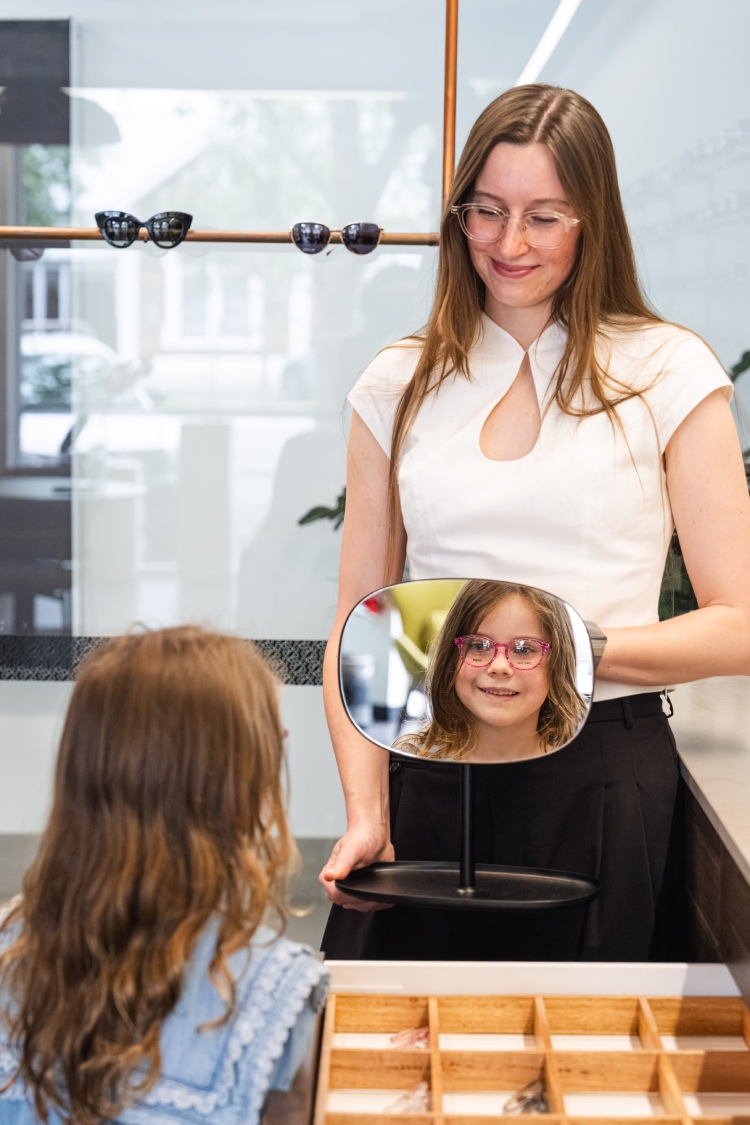
Lens selection involves more than prescription strength. Impact resistance, weight, lens thickness and the way your child uses their glasses all matter. Polycarbonate and Trivex are impact-resistant options that can suit children. The best material also depends on their prescription and lens design.4
Scratch-resistant coatings can help with everyday wear, although lenses can still scratch. An anti-reflective coating may be useful for some children, but it adds to the need for regular cleaning.4 Our spectacle lens guide explains the broader options. We can help you decide which features are relevant to your child.
Standard single vision glasses correct the blur caused by short-sightedness. Specialised myopia control glasses aim to correct vision and slow progression. Clinical trials have shown benefits from specific designs, including Hoya MiyoSmart lenses and Essilor Stellest lenses.5,6
These results do not mean every lens design works equally well, or every child will have the same response. Myopia control does not reverse existing short-sightedness. Your child still needs reviews to check their vision, prescription and eye growth.5,6
Our myopia control lenses page covers specialised spectacle options. For a broader discussion of glasses, contact lenses and other treatments, visit myopia prevention and management.
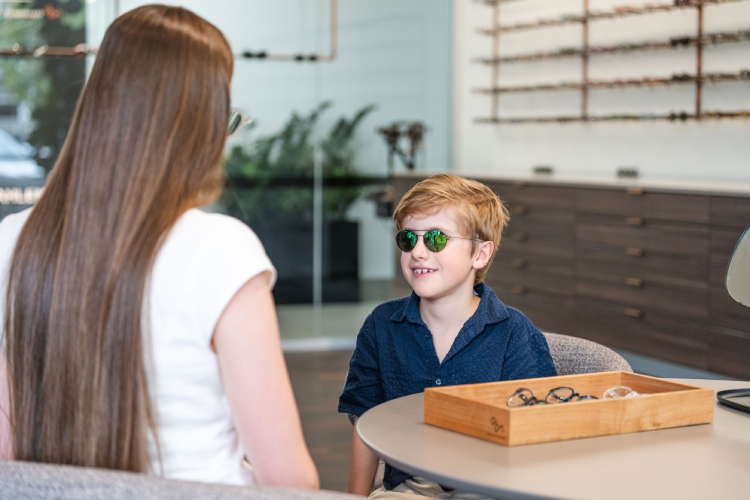
For outdoor use, choose sunglasses with verified UV protection and a close fit. A broad-brimmed hat provides extra protection around the eyes. Lens darkness alone does not tell you how much UV a lens blocks.7 Ask us about prescription sunglass lenses and tints for your child.
Everyday glasses do not replace sports eye protection. Depending on the activity, a child may need a purpose-designed sports frame, goggles or a face guard. A prescription can be incorporated into some sports eyewear.8 Tell us which sport your child plays so we can discuss what to look for.
Follow the wearing instructions provided by your optometrist. Some children need full-time wear, while others have a specific schedule. Share that advice with teachers and other carers.1
Make glasses part of the agreed routine and keep the approach positive. If your child resists wearing them, check for slipping, pressure marks or discomfort. Allow time to adjust but contact us if blur or discomfort persists rather than assuming they will simply get used to it.4

Store glasses in their case when they are off, keep the lenses away from surfaces and follow the cleaning advice supplied with them. If the frame becomes bent, bring it in for assessment instead of trying to reshape it yourself.3
Let us know if the glasses slide, sit crookedly or become uncomfortable. Keep your child’s planned eye reviews, even when the glasses appear to be working well. Children receiving treatment for a lazy eye need monitoring of vision and treatment response.2
For a first pair or an update, contact Innovative Eye Care to arrange an eye test or discuss your child’s glasses with our optical team. Bring their current glasses and any previous prescription or treatment advice.
Adelaide: 300 Wakefield Street. Phone (08) 8231 9341. Henley Beach: 330 Seaview Road. Phone (08) 8445 9050.
Contact Innovative Eye Care to arrange the next step or learn more about The Optical Dispensary.
Book your appointment now for personalised eye care tailored just for you.