Myopia, Short-Sightedness

Myopia, also called short-sightedness, causes blurred distance vision. You may notice trouble reading road signs, seeing the whiteboard at school, watching sport from a distance, or recognising faces across a room.

At Innovative Eye Care, we assess myopia at our Adelaide and Henley Beach practices. We look beyond your prescription to understand why your vision has changed and whether the eye is still growing.
Book a Myopia Eye Test
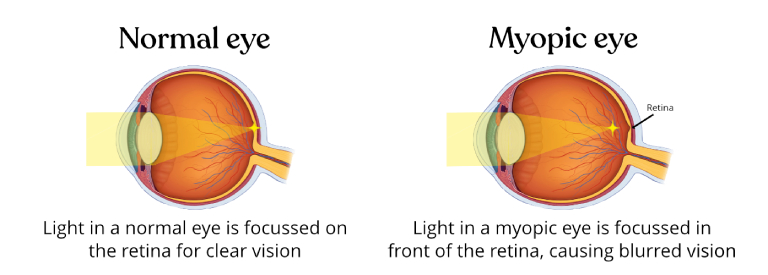
Diagram comparing light focus in a normal eye and a myopic eye

What is Myopia?

Myopia occurs when light focuses in front of the retina instead of directly on it. This can happen when the eye grows too long, or when the eye’s focusing power is too strong. The result is clearer near vision and blurred distance vision.

When myopia is linked to eye growth, it needs careful monitoring. As the eye lengthens, the tissues at the back of the eye stretch. This can increase the risk of serious eye disease later in life.

Blurred view of traffic and headlights representing distance vision with myopia

Signs of Myopia

You or your child may be short-sighted if you notice:

  • Difficulty seeing road signs, scoreboards, or the whiteboard
  • Squinting to see in the distance
  • Sitting close to screens
  • Holding books or devices close to the face
  • Headaches or tired eyes after visual tasks

A child may not realise their distance vision is blurry. An eye test can detect myopia early and help guide the right treatment plan. Childhood myopia often starts during the school years and can progress as children grow.

Child writing with their face very close to the page

What Causes Myopia?

Myopia often begins in childhood and may worsen as children grow. It can develop due to a mix of genetic, visual, and lifestyle factors.

Risk factors include:

  • Family history of myopia.
  • More time spent on close work, including screens and reading.
  • Less than two hours outdoors per day.
  • Younger age when myopia first appears.
  • Binocular vision problems, where the eyes do not work together comfortably.

Why Myopia Matters

Glasses and contact lenses can correct blurred vision, but they do not always address the eye growth behind progressive myopia.

Higher levels of myopia increase the lifetime risk of retinal detachment, glaucoma, cataracts, and myopic retinal disease. The risk rises as the eye becomes longer. When axial length exceeds 26.5 mm, the risk becomes more concerning.

Early care can help reduce future risk and may reduce the need for stronger, thicker lenses over time. Myopia control treatments aim to slow the progression of refractive error and axial elongation in children.
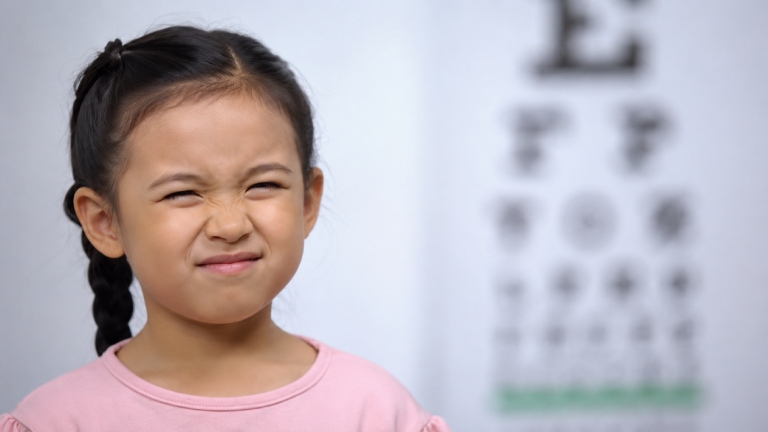
Child squinting during an eye test with a blurred eye chart in the background

Myopia in Children

Childhood myopia needs close attention because early onset increases the chance of higher myopia later. A child who becomes myopic at a younger age has more years for their prescription and eye length to progress.

At Innovative Eye Care, we assess children for myopia and discuss whether myopia control is suitable. Myopia control aims to slow eye growth, not only correct blurry vision.

Learn more about myopia control
Illustration of OCULUS eye testing equipment used in clinical eye care

How We Assess Myopia

A standard prescription check is useful, but it does not show the full picture.

Our assessment may include:

  • Prescription measurement
  • Eye health examination
  • Binocular vision assessment
  • Ocular biometry to measure axial length
  • Corneal topography or tomography when contact lens options are being considered.

The parent guide states that ocular biometry directly measures axial length and helps track eye growth. It also notes that subjective refraction alone is a poor marker for myopia control success.

Myopia Treatment Options

Children playing outdoors to support healthy vision and reduce the risk of developing myopia

Treatment depends on your age, prescription, eye health, and lifestyle.

Options may include:
  • Prescription glasses.
  • Contact lenses.
  • Lifestyle guidance.
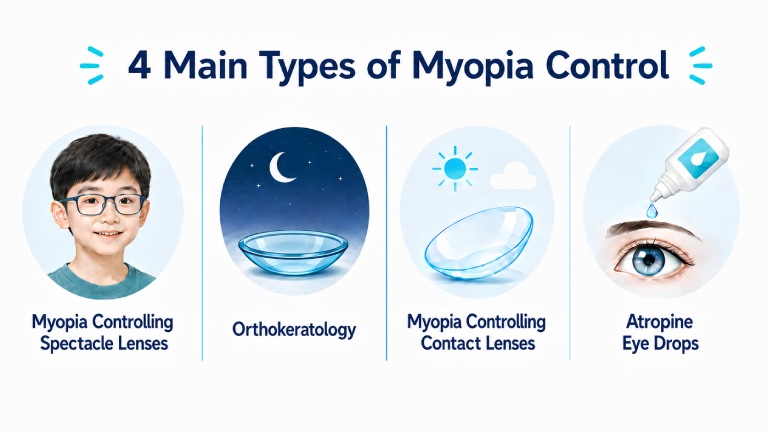
Diagram showing myopia-controlling spectacle lenses, orthokeratology, myopia-controlling contact lenses and atropine eye drops

Myopia control treatments for children and teenagers

  • Specialised spectacle lenses.
  • Orthokeratology.
  • iSight or multifocal contact lenses.
  • Atropine eye drops may be considered for myopia control.

Book a Myopia Eye Test in Adelaide or Henley Beach

Innovative Eye Care has practices at 300 Wakefield Street, Adelaide, and 330 Seaview Road, Henley Beach.

Learn more about myopia control

Frequently Asked Questions

Can myopia be cured?
Myopia cannot usually be reversed, especially when it is caused by eye growth. Glasses and contact lenses can correct blurred vision. Myopia control treatments aim to slow further progression.
How do I know if my child has myopia?
Common signs include squinting, trouble seeing the board at school, sitting close to screens, and holding books or devices close to the face. An eye test can confirm whether your child is myopic.
Does screen time make myopia worse?
More time spent on close work and less time outdoors are linked with a higher risk of myopia onset and progression. The parent guide recommends limiting recreational screen time and encouraging outdoor time.
When should children have their eyes tested for myopia?
Book an eye test if your child struggles with distance vision, squints, sits close to screens, or has a family history of myopia. Earlier assessment gives more time to manage progression.

References

  1. Flitcroft DI, He M, Jonas JB, et al. IMI - Defining and Classifying Myopia: A Proposed Set of Standards for Clinical and Epidemiologic Studies. Investigative Ophthalmology & Visual Science. 2019;60(3):M20-m30.
  2. Gifford KL, Richdale K, Kang P, et al. IMI - Clinical Management Guidelines Report. Investigative Ophthalmology & Visual Science. 2019;60(3):M184-m203.
  3. Tideman JWL, Snabel MCC, Tedja MS, et al. Association of Axial Length With Risk of Uncorrectable Visual Impairment for Europeans With Myopia. JAMA Ophthalmol. 2016;134(12):1355. doi:10.1001/jamaophthalmol.2016.4009
  4. Holden BA, Fricke TR, Wilson DA, et al. Global Prevalence of Myopia and High Myopia and Temporal Trends from 2000 through 2050. Ophthalmology. 2016;123(5):1036-1042. doi:10.1016/j.ophtha.2016.01.006
  5. Polling JR, Klaver C, Tideman JW. Myopia progression from wearing first glasses to adult age: the DREAM Study. British Journal of Ophthalmology. 2022;106(6):820-824. doi:10.1136/bjophthalmol-2020-316234
  6. Morgan IG, Wu PC, Ostrin LA, et al. IMI Risk Factors for Myopia. Invest Ophthalmol Vis Sci. 2021;62(5):3. doi:10.1167/iovs.62.5.3
  7. Xiong S, Sankaridurg P, Naduvilath T, et al. Time spent in outdoor activities in relation to myopia prevention and control: a meta-analysis and systematic review. Acta Ophthalmol. 2017;95(6):551-566. doi:10.1111/aos.13403
  8. Chua SYL, Sabanayagam C, Cheung YB, et al. Age of onset of myopia predicts risk of high myopia in later childhood in myopic Singapore children. Ophthalmic Physiol Opt. 2016;36(4):388-394. doi:10.1111/opo.12305
  9. Haarman AEG, Enthoven CA, Tideman JWL, Tedja MS, Verhoeven VJM, Klaver CCW. The Complications of Myopia: A Review and Meta-Analysis. Invest Ophthalmol Vis Sci. 2020;61(4):49. doi:10.1167/iovs.61.4.49
  10. Lam CSY, Tang WC, Tse DY yin, et al. Defocus Incorporated Multiple Segments (DIMS) spectacle lenses slow myopia progression: a 2-year randomised clinical trial. Br J Ophthalmol. 2020;104(3):363-368. doi:10.1136/bjophthalmol-2018-313739
  11. Cho P, Cheung SW, Edwards M. The Longitudinal Orthokeratology Research in Children (LORIC) in Hong Kong: A Pilot Study on Refractive Changes and Myopic Control. Current Eye Research. 2012;30(1):71-80.
  12. Chamberlain P, Bradley A, Arumugam B, et al. Long-term Effect of Dual-focus Contact Lenses on Myopia Progression in Children: A 6-year Multicenter Clinical Trial. Optometry and Vision Science. 2022;99(3):204. doi:10.1097/OPX.0000000000001873
  13. Yam JC, Jiang Y, Lee J, et al. The Association of Choroidal Thickening by Atropine With Treatment Effects for Myopia: Two-Year Clinical Trial of the Low-concentration Atropine for Myopia Progression (LAMP) Study. Am J Ophthalmol. 2022;237:130-138. doi:10.1016/j.ajo.2021.12.014
  14. Yam JC, Jiang Y, Tang SM, et al. Low-Concentration Atropine for Myopia Progression (LAMP) Study: A Randomized, Double-Blinded, Placebo-Controlled Trial of 0.05%, 0.025%, and 0.01% Atropine Eye Drops in Myopia Control. Ophthalmology. 2019;126(1):113-124.
  15. Chua W, Balakrishnan V, Tan D, Chan Y, Group AS. Efficacy Results from the Atropine in the Treatment of Myopia (ATOM) Study. Investigative Ophthalmology & Visual Science. 2003;44(13):3119.
  16. Chia A, Chua WH, Cheung YB, et al. Atropine for the Treatment of Childhood Myopia: Safety and Efficacy of 0.5%, 0.1%, and 0.01% Doses (Atropine for the Treatment of Myopia 2). Ophthalmology. 2012;119(2):347-354. doi:10.1016/j.ophtha.2011.07.031

Speak to our friendly team today

Book your appointment now for personalised eye care tailored just for you.