

Book Online
Please choose which location you would like to make an appointment for.
Astigmatism is a common reason for blurred or distorted vision. It happens when the cornea, the clear front surface of the eye, or the lens inside the eye focuses light differently in different directions. You may notice blur when reading, driving or looking at distant signs.1
Astigmatism can occur on its own or alongside short-sightedness (myopia) or long-sightedness (hyperopia). At Innovative Eye Care, we assess your prescription and eye health to help you find a suitable way to see clearly.
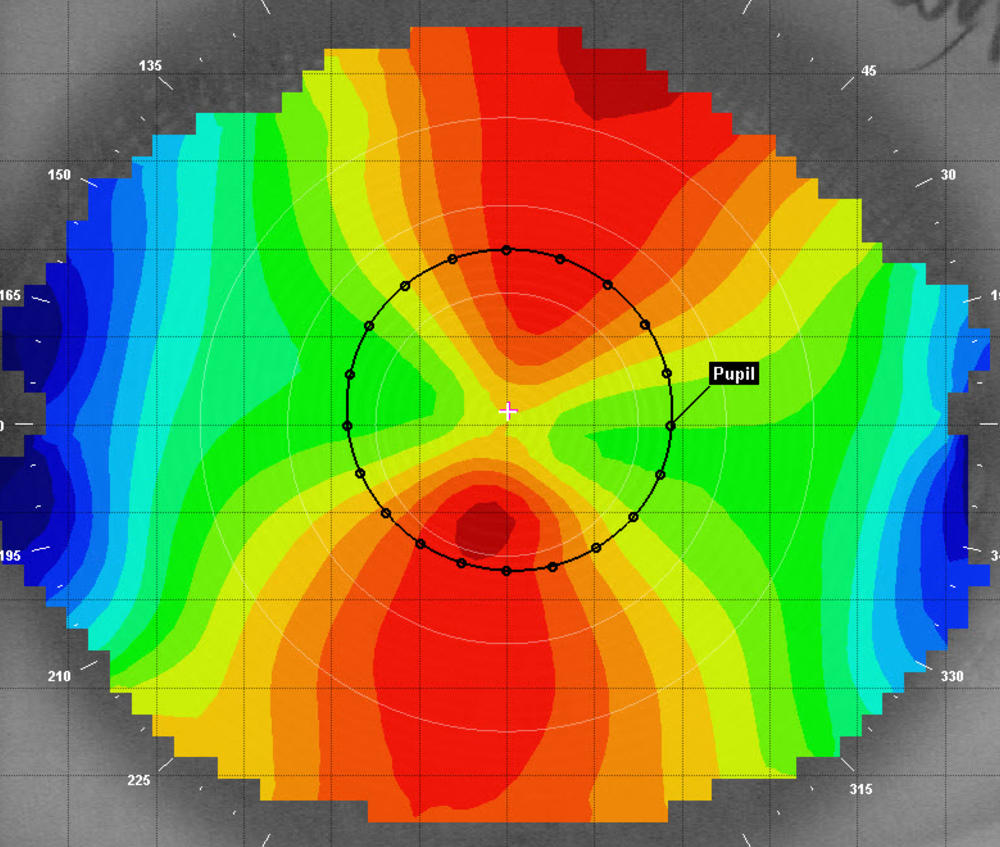

For clear vision, light needs to focus accurately at the back of your eye. In regular astigmatism, the eye has different curvatures in different directions. This prevents light from coming into a single sharp focus and can make lines or letters appear blurred, stretched or shadowed.
A simple comparison is a soccer ball, which curves evenly, versus an Australian football, which curves differently from one direction to another. This describes regular astigmatism, although real corneas have more complex shapes.
Astigmatism may cause blurred vision at distance or near, ghosting or shadowing around letters, squinting, eyestrain, headaches, or increased glare and difficulty seeing clearly at night. Some people have very few symptoms, especially when the amount is small.1,2
These symptoms have several possible causes. A comprehensive eye examination can determine whether astigmatism is contributing.
Most astigmatism relates to the natural shape of the cornea. It often runs in families and can change with age. The lens inside the eye can also contribute. Astigmatism may develop or change following eye surgery, injury, or certain corneal conditions.2,3
It is helpful to distinguish regular astigmatism, which can usually be corrected with standard prescription lenses, from irregular astigmatism, where the corneal surface is less uniform. A condition called keratoconus can cause increasing irregular astigmatism. A rapid prescription change, increasing distortion or unexplained loss of clarity deserves further assessment.
Learn more about keratoconus and how we investigate changes in corneal shape.

An optometrist measures how clearly you see and checks which lens powers improve your vision. Your examination can include an objective prescription measurement and a detailed assessment of the front of the eye. Corneal topography or tomography may be recommended if the astigmatism is high, unusual, changing or difficult to correct.1,3
Corneal imaging maps the shape of your eye and helps distinguish ordinary astigmatism from irregular corneal conditions. Not everyone needs this additional testing.
Read about our comprehensive eye examinations and keratoconus assessment.
Your glasses prescription may include SPH (sphere), CYL (cylinder) and AXIS. SPH describes short- or long-sightedness. CYL describes the amount of astigmatism, while AXIS gives the direction of that correction, measured from 0 to 180 degrees. A larger CYL number does not automatically mean you have an eye disease. Your optometrist considers these measurements alongside how clearly and comfortably you see.1
For example, a CYL of -1.50 and an AXIS of 90 describe the strength and orientation of the astigmatism correction. They do not tell you the overall health of your eyes.

Prescription glasses are a straightforward option for many people. Your lenses are made with the appropriate power and orientation to reduce blur. If your prescription changes significantly, your surroundings may initially look different while you adapt.
Toric soft contact lenses are designed to correct astigmatism. They need to sit at the correct orientation on your eye, so the fit and stability matter. Daily disposable and reusable options may be available depending on your prescription and eye health.
Explore soft disposable contact lenses.
Rigid gas permeable and scleral contact lenses can be useful when astigmatism is more complex or the corneal surface is irregular. These lenses provide a more regular optical surface and may give clearer vision than glasses in selected cases.3
Learn about rigid gas permeable lenses or specialty contact lenses for keratoconus.
Orthokeratology uses specially fitted lenses worn overnight to temporarily change the corneal shape. It can correct some astigmatism prescriptions, but not everyone is suitable. The effect is reversible and ongoing lens wear and follow-up are needed.4
Learn more about orthokeratology night lenses.
Some adults may be suitable for refractive surgery, such as LASIK or PRK, to reduce astigmatism. Eligibility depends on prescription stability, corneal shape and thickness, dry eye status and other health considerations. Surgery has potential benefits and risks and requires specialist assessment.1
Astigmatism may remain stable or change gradually over time. A noticeable or rapid increase, particularly with increasing ghosting or reduced clarity despite new glasses, should be examined rather than assumed to be a routine prescription change.
Children do not always recognise blurred vision. Significant uncorrected astigmatism can interfere with visual development and contribute to amblyopia (a lazy eye). An eye examination can identify whether glasses or monitoring are needed.1
A child may not say that things look blurry because their vision has always seemed normal to them. Parents may notice squinting, moving closer to books or difficulty seeing the classroom board. Significant astigmatism in one or both eyes can increase the risk of a lazy eye, so timely assessment and consistent use of prescribed glasses can matter.5
If your prescription is changing repeatedly, one eye is becoming noticeably blurrier, or you see persistent ghost images even with updated glasses, arrange an eye examination. In some people, increasing or irregular astigmatism is an early sign of keratoconus, where the cornea gradually changes shape. Corneal topography or tomography can help assess this, particularly in children and younger adults.3
If you have itchy eyes, try not to rub them forcefully. Discuss persistent itch or allergies with your optometrist so the cause can be managed. Eye rubbing is an important consideration when assessing people at risk of keratoconus.3
Sudden vision loss, severe eye pain or an acute change in vision is not typical of simple astigmatism. Seek urgent eye care rather than waiting for a routine prescription check.
If your vision is blurred, your glasses no longer seem clear, or you have noticed increasing distortion, arrange an eye examination at Innovative Eye Care. We have practices at 300 Wakefield Street, Adelaide, and 330 Seaview Road, Henley Beach.
Contact our team or book an appointment to discuss your vision.
Book your appointment now for personalised eye care tailored just for you.