

Book Online
Please choose which location you would like to make an appointment for.
Your child does not need to read letters or explain what they see to have their eyes assessed. Optometrists can use observation and age-appropriate tests to check early vision, eye alignment and whether glasses may be needed.1
At Innovative Eye Care, we provide children’s vision care at our Adelaide and Henley Beach practices. For a baby or toddler, the aim is to gather useful information, explain any concerns and arrange the right next step.
If we find something that needs a closer look, we may refer your child to a children’s eye specialist, called a paediatric ophthalmologist. We will explain why this is needed and how soon your child should be seen.2
To discuss the right appointment for your child, contact our team and tell us their age and what you have noticed.

An assessment can help identify significant prescription differences, an eye turn or signs that one eye is developing weaker vision. A child can have a lazy eye, called amblyopia, without an obvious eye turn.3
Depending on the findings, care may involve glasses, monitoring or shared care with an ophthalmologist. Glasses improve focus when a significant prescription is present. Patching may be prescribed for a lazy eye, with the amount and follow-up tailored to the child. Do not start patching without professional advice.3
Our role also includes explaining what we could assess, what remains uncertain and whether your child needs further testing. You should leave with a clear next step.
Ask for advice if you notice an eye turning, unusual eye movements, a persistent head tilt or concern about how your child looks at people and objects. Mention a family history of childhood eye disease, premature birth or an existing medical or developmental condition.4
You do not need to wait until preschool if you have a concern. Keep your child’s newborn and routine child health checks, and attend any specialist follow-up already arranged. This page does not replace those visits.2
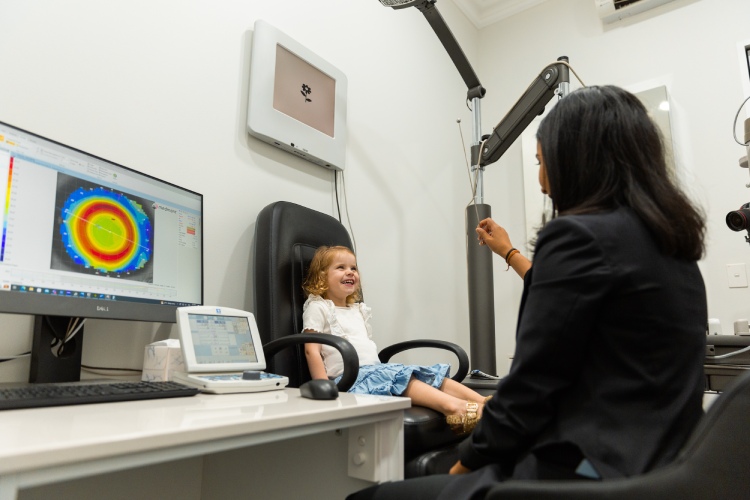
We begin with your concerns, birth and medical history, family eye history and any previous results. Testing depends on age, development and cooperation.1
Looking and visual responses
For babies, assessment may involve watching how they fix on and follow a target. Older toddlers may be able to match pictures or symbols. We try to assess each eye separately where possible.1
Eye alignment and health
The optometrist may check eye movements, alignment, pupils, eyelids and the red reflex, the reflection seen when light is shone into the eyes. The view inside the eyes depends on cooperation and whether dilation is possible.1

Retinoscopy uses a light and lenses to estimate the prescription without spoken answers.3 Drops may be needed to temporarily relax focusing and enlarge the pupils for a more accurate assessment. The clinician chooses drops for the child’s age and health, and explains temporary blur, light sensitivity and possible adverse effects.3
Babies and toddlers cannot always sit still, look where we need them to or complete every test. This means we may not get all the information we need in one visit. Occasionally, a specialist may recommend an examination while a child is asleep under anaesthesia so their eyes can be checked properly.5
Watching your child follow a toy gives us useful information, but it cannot tell us exactly how clearly each eye sees.1
If we cannot finish an important part of the eye test, we will explain what still needs checking. Your child may need another visit or an appointment with a specialist. We will not assume everything is normal because your child could not complete a test.
Some eye problems need tests or treatment from a children’s eye specialist. We may recommend this if your child is not seeing as expected, has an eye turn, has a drooping eyelid or shows signs of a problem inside the eye.2
A referral helps your child get the care they need. We can share our findings with the specialist and continue to help with glasses and follow-up where appropriate. If your child already sees an eye specialist, keep those appointments.

Seek urgent same-day medical or ophthalmology advice for a white pupil or unusual white reflection in photographs, a sudden eye movement abnormality, sudden loss of visual responses, an eye injury, or a newly drooping eyelid. A red eye in a newborn also needs urgent assessment.6
Contact an emergency department if you cannot obtain urgent advice. Do not wait for a routine booking or a repeat photograph to confirm a white pupil.
When booking, tell our team your child’s age, your concerns and whether a doctor or nurse recommended the assessment. This helps us advise on the most appropriate appointment.
Choose a time when your child is usually alert. Bring a comfort toy, current glasses, the child health record and any previous eye reports. Photos or short videos of an intermittent eye turn can help you show what you have noticed. They do not replace an examination.
Ask whether drops are likely and whether you should allow extra time. There is no need to practise letters or coach your child before the visit.
If you are unsure where to start, contact our team. Tell us your child’s age, what you have noticed and whether they already see an eye specialist. We can help you arrange an appropriate next step.
Adelaide: 300 Wakefield Street. Phone (08) 8231 9341. Henley Beach: 330 Seaview Road. Phone (08) 8445 9050.
For information about care as your child grows, explore our children’s vision care.
Book your appointment now for personalised eye care tailored just for you.